
March 6, 2026
By B Nimri Aziz
“Come out. Stand in the sun; don’t stay there in the shade.” More than 40 years ago, with this empathic gentle invitation, Jesse Jackson helped bring Arabs into the Rainbow Coalition.
It was rather late for a long-established American community. For too long Arab Americans had quietly accepted marginalization here. Jackson showed it was up to us to end that. (Today there are close to 400 elected Arab Americans serving in local and state governments.)
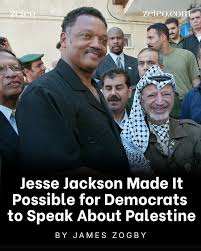
In 1984, Jesse Jackson was the first Black contender for the US presidency. He had broken other barriers by openly calling for Palestinian statehood. He embraced both PLO leader Yasser Arafat and the Cuban revolutionary Fidel Castro. The tall, gentle man with that penetrating confidence had been at work awakening Americans, especially Blacks, for a quarter of a century. But he had a wider mission for me and quietly waiting Arabs in the US. That’s how he came to be the first ‘politician’ – and the first African American leader – I had ever encountered face-to-face. His vision would include immigrants from the Middle East. I suspect many of those hearing him on the occasion when I met Jackson were in the same penumbral place where he reached me.
We were attending a modest workshop on political leadership in Washington. The 1980s was rather late for this kind of lesson. We were immigrants. But not newcomers. We were the children and grandchildren of families who reached US shores over a century earlier. Though still shy; even though our uncles and brothers fought and died World War II on the side of the Allies. A multi-faith and multi-ethnic mosaic, we remained unrecognizable.
Somehow, regrettably, we were hardly touched by the explosive civil rights movement across the USA that inspired widespread awakenings. Not even by the lessons of iconic Muslim American voices Muhammad Ali and Malcolm X Malik Shabazz. Not by the great Black writers James Baldwin, Maya Angelou and Toni Morrison of that era either. Why, I don’t know. Perhaps military occupation of our parents’ homelands distracted us. That certainly drained our resources since our priority was to help our besieged families overseas. American politics was for us an amorphous foreign policy issue.
Support candidates with financial contributions. That would drawn us into party politics, we were told. OK. But what happens when you are rebuffed? Insulted? As an Arab American donor to (Democratic) presidential candidate Walter Mondale was. Check retuned, with a press release announcing our efforts were suspect.
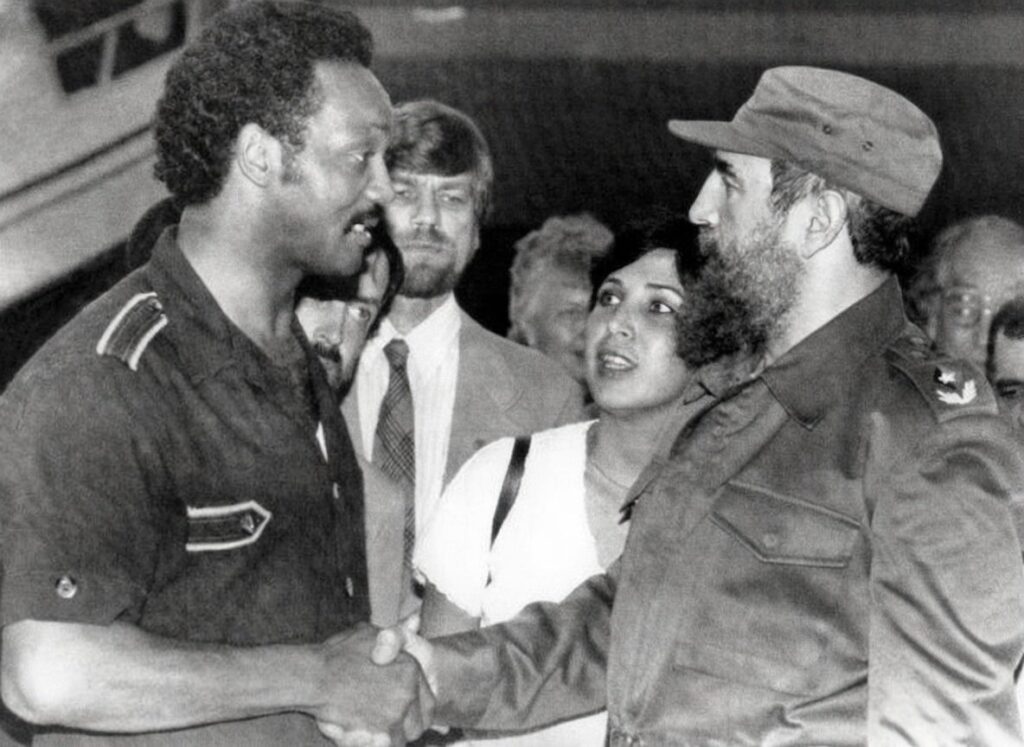
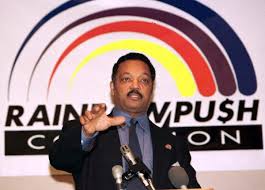
Political participation wasn’t as simple as we expected. But maybe that public slap in the face was a needed wake-up-call. Because not long after that an essential national-level partnership emerged. Jesse Jackson showed up just when a new organization Arab American Institute was in place. It’s aim: recruiting our community into local politics. AAI’s head, James Zogby teamed up with Jackson to bring us into the Rainbow Coalition. It was at one of their workshops in 1986 when Jackson’s tender yet urgent invitation came – “Come; stand in the sun”.
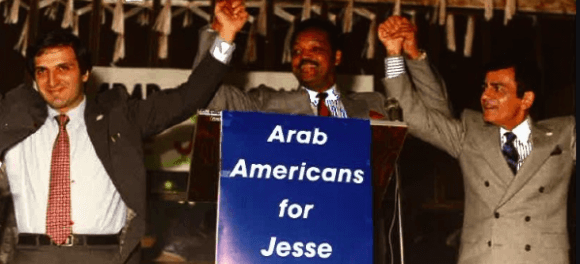
Jim Zogby, Jesse Jackson, Casey Kassem 1980s